Novera Pest SpecialistsNovera Pest Specialists

Carpenter Ant and Nuisance Ant Suppression Cincinnati

Nuisance ant species like odorous house ants forage for residential kitchen carbohydrates, whereas carpenter ants actively excavate structural wood framing, roof valleys, and foam insulation to establish brood…
Get My Estimate →(513) 812-8087
Carpenter Ant and Nuisance Ant Suppression in Cincinnati, oh
Quick answer
  • Comprehensive service covers interior nesting-void injections, targeted non-repellent transfer chemistry, exterior perimeter soil barriers, and tree canopy branch-trimming evaluations.
  • Initial diagnostic on-site evaluations and targeted barrier treatments deploy within 24 to 48 hours across urban and suburban properties.
  • Remediation services begin at a $300 minimum diagnostic and initial knockdown threshold, scaling with structure square footage and nesting complexity.
  • Protocol targets structural Camponotus pennsylvanicus (black carpenter ants), Tapinoma sessile (odorous house ants), and pavement ants nesting in walls, framing, and insulation.
  • Schedule on-site evaluation by calling (513) 812-8087, where a field technician verifies nesting distribution before applying treatments.

Nuisance ant species like odorous house ants forage for residential kitchen carbohydrates, whereas carpenter ants actively excavate structural wood framing, roof valleys, and foam insulation to establish brood galleries. Homeowners near moist, wooded corridors, such as parcels surrounding Eden Park in Walnut Hills or mature shade trees in Hyde Park and Clifton, frequently encounter spring swarmers emerging from wall voids. The biological distinction matters: nuisance ants trigger contamination anxiety across food preparation counters, while untreated carpenter ant colonies compromise framing studs, fascia boards, and sill plates. Addressing these structural incursions requires understanding insect behavior rather than applying broad-spectrum retail sprays that scatter multi-queen colonies via budding.

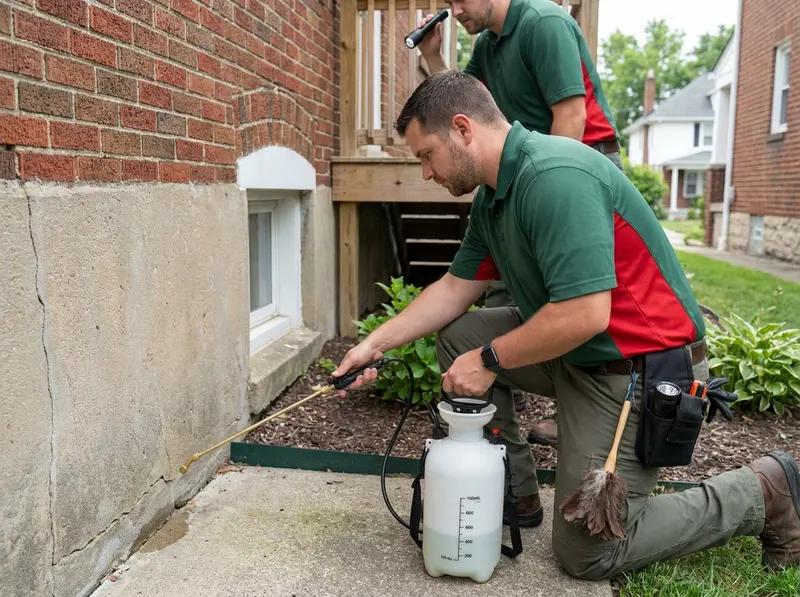
Effective eradication leverages Integrated Pest Management principles codified by federal authorities. Instead of repellent chemicals that trap foraging insects indoors, technicians implement undetectable liquid transfer products alongside species-specific carbohydrate or protein micro-baits. Structural guidelines from the Michigan State University Extension demonstrate that carpenter ants maintain primary parent nests inside moisture-damaged outdoor timber or stumps, frequently documented near historical properties in Mount Adams and Northside, while positioning satellite colonies inside heated wall cavities. Remediation combines interior void dustings using precision delivery tools with targeted ground-level barriers applied under Ohio Department of Agriculture pesticide regulations.

Properties in Westwood, Pleasant Ridge, and Oakley face recurring moisture intrusion along aged box gutters, roof flashings, and crawlspaces, creating primary nesting zones for Camponotus species. Moisture management constitutes a necessary partner to chemical suppression; treating insect colonies without eliminating water leaks leaves fungal-softened framing vulnerable to immediate re-infestation from adjacent yards. Following guidelines outlined by the Penn State Extension entomology department, technicians map active trail networks across foundations, utility conduits, and masonry joints, ensuring treatments neutralize subterranean and void-bound queens rather than temporary surface foragers.

    Step 1: Perform systematic moisture metering and thermal mapping across baseboards, window assemblies, and plumbing chases to pinpoint active nesting galleries. Step 2: Identify exact species morphology to select appropriate biological bait matrix formulations. Step 3: Drill microscopic access points to deliver specialized dry particulate desiccant directly into interior wall cavities housing brood clusters. Step 4: Apply a continuous band of non-repellent liquid barrier along perimeter foundation footings per label instructions. Step 5: Conduct a follow-up assessment 21 days post-application to evaluate bait consumption and verify complete colony mortality.

How much does Carpenter Ant and Nuisance Ant Suppression cost in Cincinnati?

Exterior Foundation Barrier & Kitchen Interior Gel Baiting (Up to 2,000 sq ft)$300 - $425
Carpenter Ant Satellite Void Injection & Perimeter Treatment (Single Structural Zone)$375 - $550
Whole-Structure Multi-Story Colony Remediation with Sub-Sill Injections$550 - $950
Seasonal Maintenance Suppression Barrier (Post-Remediation Property Plan)$300 - $450

Every job gets a firm, written price after an on-site visit.

Common questions

How do technicians distinguish between carpenter ants and termites in Cincinnati properties?
Carpenter ants possess a pinched waist, elbowed antennae, and uneven fore-and-hind wings, whereas subterranean termites exhibit straight antennae, uniform waist thickness, and equal-length wings. Carpenter ants also do not consume cellulose; they expel clean wood shavings known as frass outside their gallery exit holes, visible near floor joists and basement sills across older Hamilton County homes.
Why do store-bought perimeter sprays fail against odorous house ants in Over-the-Rhine residences?
Synthetic pyrethroid aerosol sprays irritate odorous house ants, causing their polygynous colonies to undergo budding, wherein multiple queens fracture into separate rooms. Professional suppression utilizes slow-acting non-repellent active ingredients compliant with OSHA occupational safety standards, permitting worker ants to transport toxic active chemistry into central brood chambers before mortality occurs.
What exterior factors drive carpenter ant infestations in Mount Lookout and Walnut Hills?
Overhanging canopy limbs, damp leaf litter accumulation, and wood-to-ground contact around historic architecture establish natural foraging highways into attic vents and siding joints. Environmental monitoring standards published by the United States Department of Agriculture confirm that dead hardwood tree limbs within 20 feet of a roofline substantially raise carpenter ant entry vectors.
Are the suppression products applied around Cincinnati homes safe for pets and children?
Suppression protocols follow structural guidelines enforced by the Centers for Disease Control and Prevention environmental health services, focusing products into closed wall voids, exterior foundation crevices, and tamper-resistant bait enclosures inaccessible to companion animals. Liquid foundation barriers bind securely to substrate surfaces once dry, generally within two hours under standard humidity.
How does moisture damage accelerate ant colonization in Cincinnati riverfront communities?
Water-damaged architectural framing allows worker ants to carve galleries rapidly without expending metabolic energy against dense, healthy wood grain. Building inspection resources from the U.S. Department of Housing and Urban Development and moisture mitigation standards from the Institute of Inspection Cleaning and Restoration Certification emphasize that drying structural lumber below 15% moisture content prevents wood-destroying insect recurrence. Homeowners can reach Novera Pest Specialists by calling (513) 812-8087 to schedule an on-site structural assessment.

Get started today

Tell us about your carpenter ant and nuisance ant suppression job in Cincinnati and we'll send a clear, written quote, usually the same day.

Get your PEST CONTROL SEVICE quote, Cincinnati

We only use your ZIP to check availability, no spam.